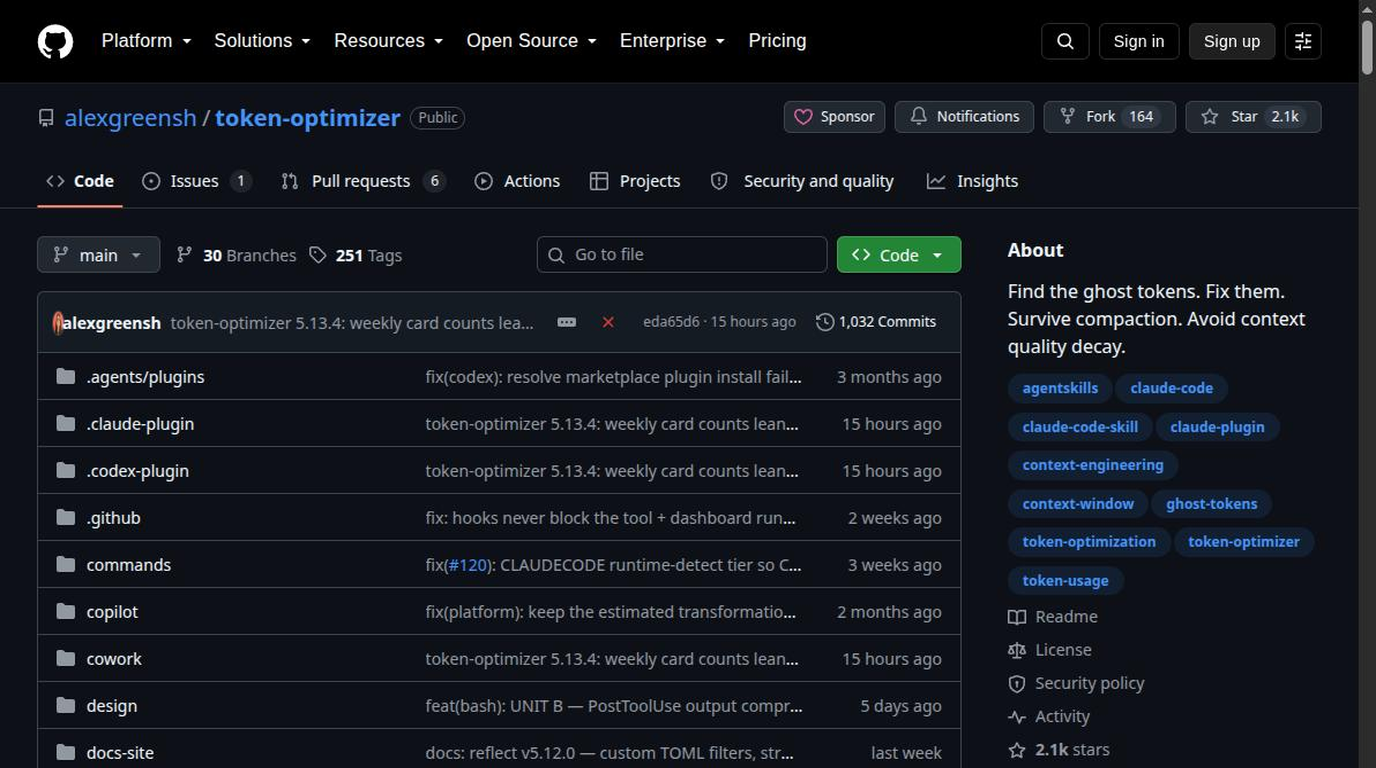
I wrote earlier about four skills that cut my Claude Code bill. Since then I added a fifth, and it is a different kind of animal. Caveman, ponytail, antigravity and handoff change how Claude behaves. Token Optimizer measures what your setup is already wasting and then goes and fixes it.
What it actually is
It ships as a Claude Code plugin, two slash commands and a handful of skills. Install is two lines:
/plugin marketplace add alexgreensh/token-optimizer
/plugin install token-optimizer@alexgreensh-token-optimizer
Then run /token-optimizer once to wire up the hooks, and after that most of it runs on its own. Zero dependencies, zero telemetry, Python 3.9 and up, and it works across Claude Code, Codex, OpenCode, OpenClaw, Hermes and Copilot.
Tools like Headroom and RTK compress command output, which is maybe a fifth of your context. Token Optimizer covers that plus the parts nobody looks at: bloated config files, skills loaded on every session that you never invoke, stale memory entries, work lost to compaction, and turns that ran on a heavier model than the job needed.
The skills
/token-optimizeris the full audit. It finds the waste, fixes it, and tells you what it saved./token-optimizer:quickis a ten second context health score./token-optimizer:healthscans your running sessions for zombies.token-coachplans an efficient setup rather than auditing an existing one.fleet-auditorruns the same audit across every agent runtime on the box.resume-checkpointpulls back the state you lost to a compaction.
Running the health check
Agent processes do not always die when you close the window, and you cannot see that from inside a session.
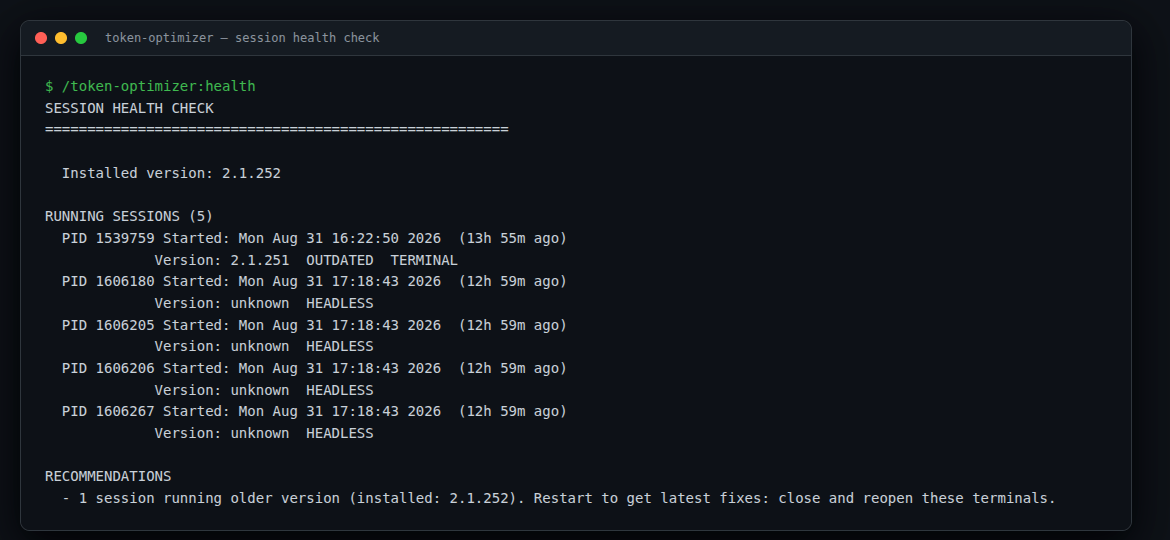
Five sessions on my machine. One terminal session almost fourteen hours old and running an outdated build, plus four headless processes from a background job. Nothing stale enough to flag as a zombie, so nothing to kill. The tool never kills anything on its own, which is the right call given how easily a legitimate background agent looks like a leak.
It blocked a repeat call
Putting the screenshots together, I asked for a second capture with the same arguments as the first. The plugin blocked the call:
this exact call already ran and its full result is archived on disk, re-fetching would re-inflate context with data you already have
It was wrong about the page, since I had navigated somewhere else in between. It was right about the pattern. Repeat tool calls with identical arguments are one of the quiet ways a session doubles its own weight, and I would never have noticed the habit if something had not stopped me doing it.
The numbers
The repo publishes a benchmark from one user’s thirty days: about $313 a month logged event by event, and about $1,877 a month when the whole workload is priced the old way against the new. The first number is metered, the second is an estimate, and the author keeps them in separate tables rather than adding them together. Your mileage depends entirely on how heavily you use the thing.